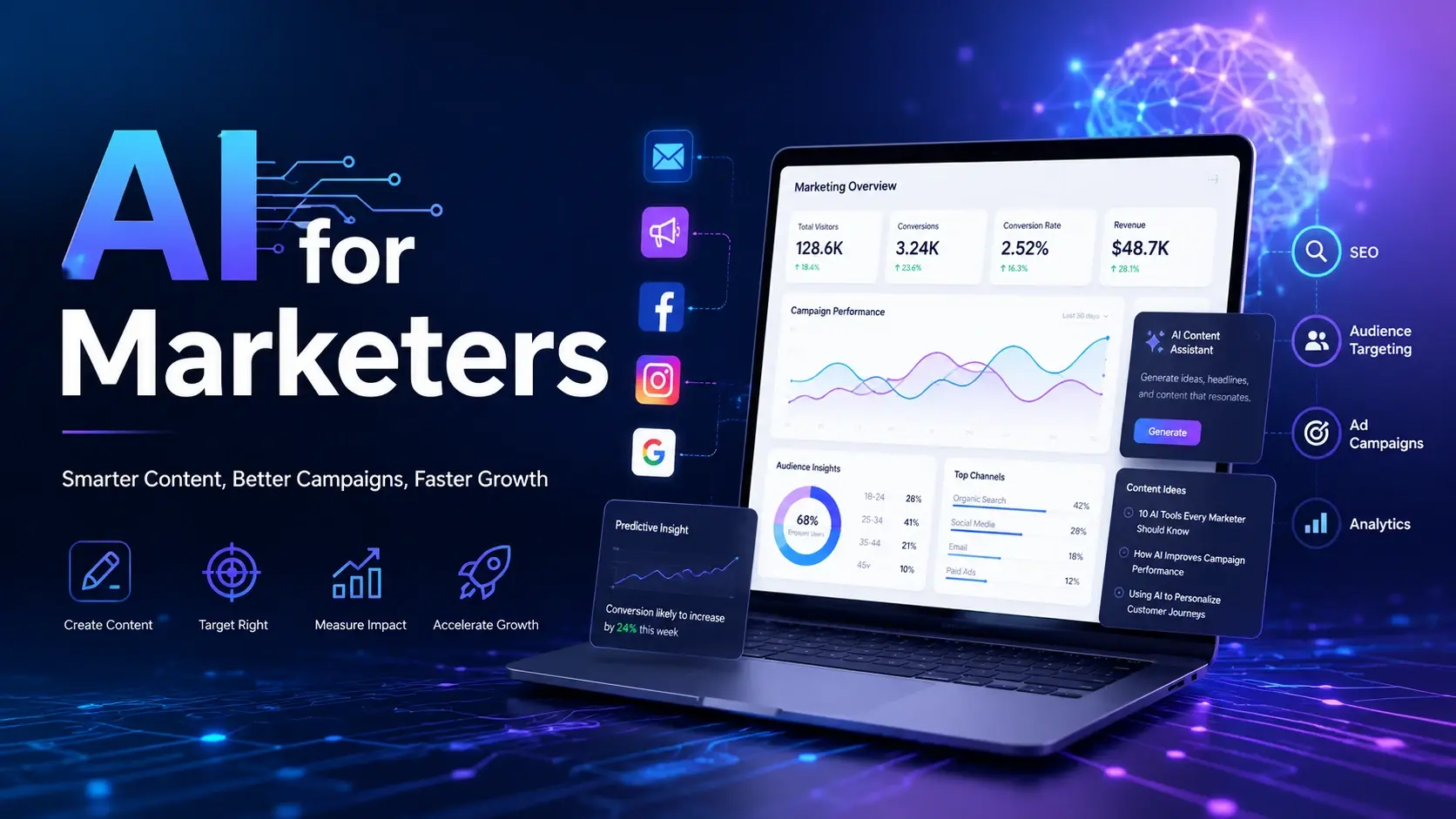
Artificial intelligence is no longer a futuristic concept in marketing. Today, AI for marketers has become a practical advantage for brands, agencies, freelancers, and businesses that want to create better content, understand customers faster, and improve campaign performance.
Marketing has always depended on creativity, data, timing, and customer psychology. The difference now is that AI helps marketers handle these areas with more speed and accuracy. From writing ad copy to analyzing customer behavior, AI gives marketing teams the ability to work smarter without losing the human touch that makes a brand memorable.
What Is AI for Marketers?
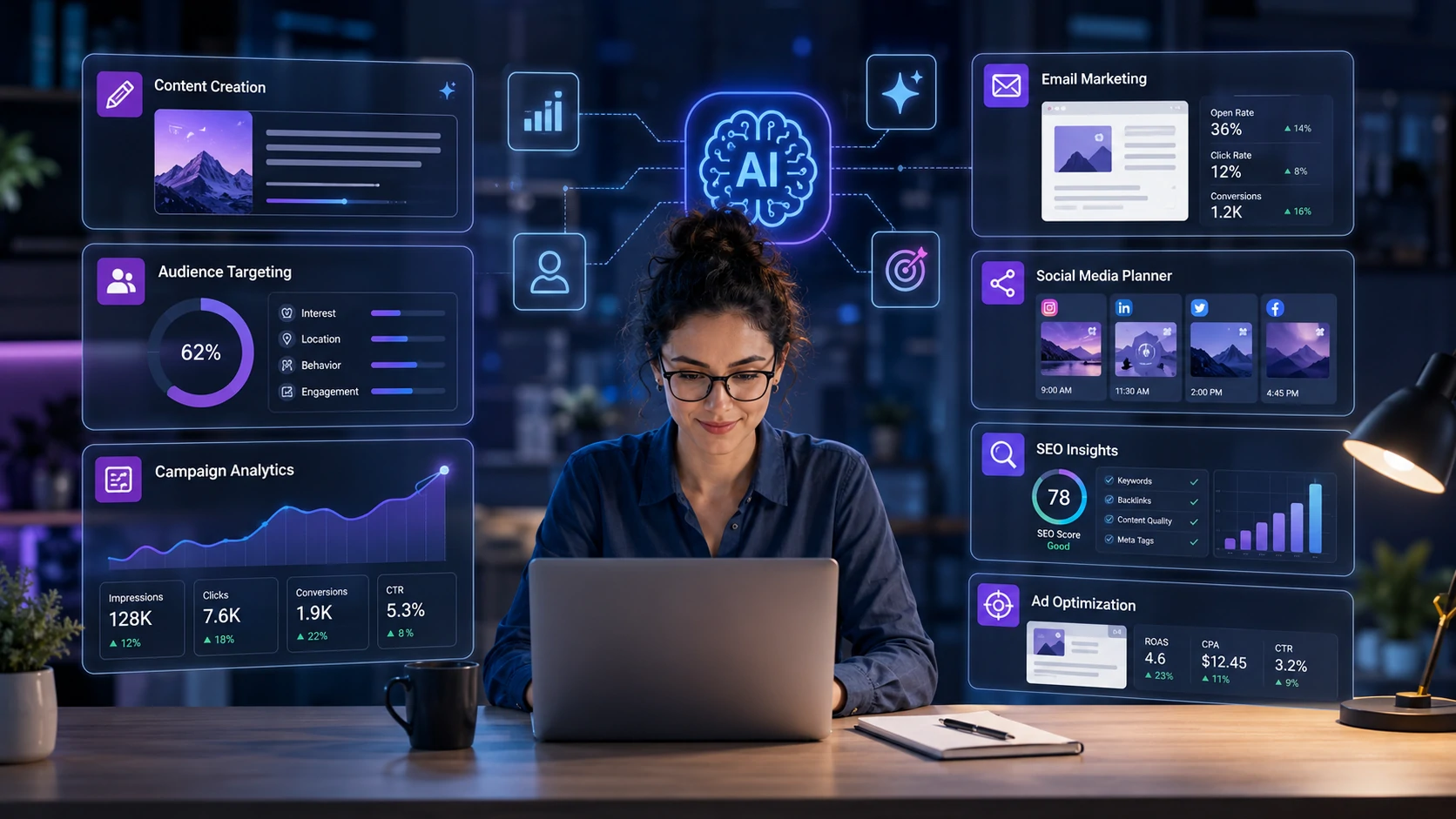
AI for marketers refers to the use of artificial intelligence tools and systems to improve marketing tasks. These tools can help with content creation, customer segmentation, SEO research, email marketing, social media planning, ad optimization, lead scoring, reporting, and personalization.
Instead of replacing marketers, AI works best as a support system. It can generate ideas, summarize data, suggest improvements, automate repetitive tasks, and help marketers make better decisions. The most successful marketers are not the ones who simply use AI, but the ones who know how to guide it with strong strategy, clear prompts, and human judgment.
According to HubSpot’s 2026 State of Marketing Report, AI has become a core part of modern marketing workflows, with marketers using it heavily for content creation and media production. HubSpot also notes that AI is now a baseline rather than a true differentiator, meaning the real advantage comes from how well teams use it.
Why AI Matters in Marketing
Marketing teams are under constant pressure to produce more content, manage more channels, personalize more messages, and prove better results. AI helps solve this problem by reducing manual work and improving execution speed.
For example, a marketer can use AI to turn one long article into social media posts, email newsletters, ad variations, video scripts, and landing page copy. Instead of starting from zero every time, AI gives marketers a strong first draft that can be edited and refined.
AI also helps marketers understand large amounts of data. Campaign reports, website analytics, customer feedback, and sales data can be difficult to analyze manually. AI tools can quickly identify patterns, highlight what is working, and suggest where improvements are needed.
Salesforce’s State of Marketing report shows that modern marketing is moving toward personalized, two-way customer engagement, while many marketers still struggle with using data effectively for those moments. This is exactly where AI can help: connecting customer data with more relevant communication.
Key Benefits of AI for Marketers
One of the biggest benefits of AI for marketers is speed. Tasks that once took hours can now be completed in minutes. This includes writing headlines, generating content ideas, creating campaign briefs, building customer personas, and preparing reports.
Another major benefit is personalization. AI can help marketers create messages that match different audience segments. Instead of sending the same message to everyone, brands can create content based on customer interests, behavior, location, purchase history, or stage in the buying journey.
AI also improves testing. Marketers can create multiple versions of an ad, headline, email subject line, or landing page section. This makes it easier to test what performs best and optimize campaigns based on real results.
In paid advertising, AI has become especially important. Google’s AI Max for Search campaigns uses AI-powered targeting and creative enhancements to help advertisers reach new queries and adapt ad content to user intent. Google reported that advertisers activating AI Max typically saw more conversions or conversion value at a similar CPA or ROAS.
Best Use Cases of AI for Marketers
AI can support almost every part of the marketing workflow. For content marketers, AI can help generate blog outlines, rewrite paragraphs, create social posts, suggest titles, and repurpose long-form content.
For SEO specialists, AI can help with keyword clustering, content briefs, search intent analysis, meta descriptions, FAQ sections, and competitor content reviews. However, human review remains essential because SEO requires accuracy, originality, and a deep understanding of the audience.
For social media marketers, AI can generate post ideas, captions, hooks, content calendars, and engagement replies. It can also help turn one idea into different formats for X, LinkedIn, Instagram, TikTok, and YouTube Shorts.
For email marketers, AI can help write subject lines, segment audiences, personalize email copy, and create automated sequences. This is useful for newsletters, product launches, abandoned cart campaigns, onboarding emails, and reactivation campaigns.
For performance marketers, AI can support ad copywriting, audience research, creative testing, budget insights, and landing page optimization. As search and advertising become more AI-driven, marketers need to understand how AI affects discovery, intent, and conversion.
Google is also testing new Gemini-powered ad formats in Search, including conversational and AI-assisted ad experiences designed to give users more relevant product guidance. This shows that AI is not only changing how marketers create campaigns, but also how customers discover and evaluate products.
AI Tools Marketers Can Use
There are many AI tools available for marketers, and the best choice depends on the task. For writing and ideation, marketers often use tools like ChatGPT, Claude, Gemini, Jasper, and Copy.ai. For design and creative production, Canva, Adobe Firefly, and Midjourney can help create visuals and campaign assets.
For SEO and content optimization, tools like Semrush, Ahrefs, Surfer SEO, and Clearscope can help with keyword research, content planning, and competitor analysis. For automation and CRM-based marketing, HubSpot, Salesforce, Mailchimp, ActiveCampaign, and Zapier offer AI-powered workflows and customer communication features.
Prompt tools can also be useful for marketers who want better outputs from AI. A platform like GeneratePrompt.ai can help marketers create stronger prompts for content, images, videos, ads, product descriptions, and campaign planning. The better the prompt, the better the AI result.
The Human Side of AI Marketing
Although AI is powerful, it should not remove the human side of marketing. Customers still care about trust, emotion, clarity, and real experience. A brand that uses AI only to produce generic content will quickly sound like everyone else.
This is why marketers need to combine AI with brand strategy. AI can help produce content, but the marketer must decide the message, positioning, tone, audience, and goal. AI can suggest ideas, but humans must choose the ideas that match the brand.
The best marketing teams use AI to save time on repetitive work so they can spend more energy on strategy, creativity, storytelling, customer understanding, and business growth.
Challenges of Using AI in Marketing
AI also comes with challenges. One of the biggest risks is producing generic or inaccurate content. AI tools can sometimes create information that sounds correct but is not fully reliable. This is why marketers should always review facts, check sources, and edit content before publishing.
Another challenge is brand consistency. If multiple team members use AI without clear guidelines, the brand voice can become inconsistent. Businesses should create AI content rules, tone-of-voice guidelines, prompt libraries, and review processes.
There is also the issue of over-automation. Customers can often feel when a brand sounds robotic or impersonal. AI should improve communication, not make it colder.
How to Start Using AI as a Marketer
The best way to start using AI is to choose one clear marketing task and improve it. For example, start with content ideas, email subject lines, ad copy, or social media captions. After that, build repeatable workflows.
Marketers should also create a prompt library. This can include prompts for blog writing, SEO briefs, LinkedIn posts, ad campaigns, customer personas, video scripts, and analytics summaries. Over time, this library becomes a valuable marketing asset.
It is also important to measure results. AI should not be used only because it is popular. Marketers should track whether AI is saving time, improving content quality, increasing conversions, reducing costs, or helping the team make faster decisions.
The Future of AI for Marketers
The future of AI for marketers will be more personalized, automated, and data-driven. AI agents may soon manage larger parts of marketing workflows, from researching audiences to building campaigns and generating reports.
However, the marketer’s role will remain important. The future belongs to marketers who can combine AI skills with strategy, creativity, psychology, and business thinking. AI can create content, but marketers create meaning. AI can analyze data, but marketers turn insights into action.
Conclusion
AI for marketers is not just about creating faster content. It is about building smarter marketing systems. When used correctly, AI helps marketers understand audiences, improve campaigns, personalize communication, and save time.
But AI is only as strong as the strategy behind it. The best results come when marketers use AI as a creative assistant, research partner, automation tool, and performance enhancer — while keeping human judgment at the center.
In a world where almost every brand can use AI, the real advantage is not simply having access to the tools. The real advantage is knowing how to use AI with clarity, creativity, and purpose.