In the rapidly evolving landscape of generative AI, a new paradigm is shifting the way creators, developers, and businesses interact with Large Language Models (LLMs) and image generators. For years, the focus has been on "forward prompting"—the art of crafting the perfect input to cajole a machine into producing a desired output. But as models become more complex and "black box" in nature, a powerful counter-strategy has emerged: Reverse Prompting.
This technique, which essentially flips the script by asking the AI to deduce the prompt that would have created a specific piece of content, is unlocking new levels of consistency and creativity. It moves the user from the role of a guesser to that of an architect. When combined with advanced concepts like Meta-prompting and Self-refinement, and facilitated by specialized Prompt engineering tools like generateprompt.ai, reverse prompting becomes the ultimate skill for mastering AI.
This article explores the mechanics of reverse prompting, its theoretical underpinnings, and provides a comprehensive guide on how to leverage cutting-edge tools to reverse engineer success.
The Mechanics of Reverse Prompting
What is Reverse Prompting?
At its core, reverse prompting (often called Reverse Prompt Engineering or RPE) is the process of working backward from a finished output—be it a paragraph of text, a line of code, or a digital image—to reconstruct the specific instructions, constraints, and stylistic parameters that generated it.
In a traditional workflow, you might type:
"Write a professional email to a client about a delay."
In a reverse prompting workflow, you would feed a perfectly written email into an AI and ask:
"Analyze this email. Write the exact prompt that would cause an LLM to generate this specific text, capturing the tone, structure, and underlying psychological intent."
Why Is This Necessary?
The necessity of reverse prompting arises from the inherent opacity of modern AI models. When you see a breathtaking AI-generated image or read a flawlessly nuanced AI article, the specific combination of words (tokens) that triggered that result is often invisible.
- Replicability: You cannot replicate a happy accident without the recipe. Reverse prompting recovers the recipe.
- Deconstructing "Magic": It demystifies the "black box" behavior of models like GPT-4 or Midjourney.
- Style Transfer: It allows you to extract the "DNA" of a specific writing style or visual aesthetic and apply it to new subjects.
Advanced Concepts: Meta-Prompting and Self-Refinement
To truly understand the power of reverse prompting, we must contextualize it within two broader sub-keywords of the AI industry: Meta-prompting and Self-refinement.
Meta-Prompting: The Architect's Blueprint
Meta-prompting takes prompt engineering to a structural level. Instead of writing a prompt for a single task, you write a prompt that instructs the AI on how to write prompts.
Reverse prompting is the fuel for meta-prompting. By reverse-engineering hundreds of successful outputs, you can identify the common structural elements (the "meta-structure") that yield high quality. You can then feed these structures back into the AI.
- Example: "You are an expert prompt engineer. Based on the following three examples of high-converting marketing copy (A, B, and C), construct a meta-template that can generate similar copy for any product."
Self-Refinement: The Iterative Loop
Self-refinement is the process where an AI critiques and improves its own output. In the context of reverse prompting, this creates a virtuous cycle:
- Generate: The AI guesses the prompt for an image.
- Test: You use that guessed prompt to generate a new image.
- Compare: You compare the new image to the original.
- Refine: You ask the AI, "The result was too dark compared to the original. Refine the prompt to correct the lighting."
This loop is critical for achieving high-fidelity results, but it can be tedious to perform manually. This is where specialized tools come into play.
The Rise of Prompt Engineering Tools
As the complexity of prompts increases, "guessing" is no longer a viable strategy. The market has responded with a wave of Prompt engineering tools designed to automate the analysis and generation of prompts.
While general chatbots like ChatGPT can attempt text-based reverse prompting, they often struggle with multimodal tasks—specifically, reverse engineering images. Visual data contains millions of pixels that represent complex concepts like lighting (volumetric, cinematic), camera specs (ISO, aperture), and artistic styles (cyberpunk, impressionism). A standard text LLM cannot "see" these nuances without a vision encoder.
This gap is where generateprompt.ai distinguishes itself as a market leader, offering dedicated tools that bridge the gap between visual inspiration and textual instruction.
Spotlight on GeneratePrompt.ai
GeneratePrompt.ai is a specialized platform designed to democratize access to high-level prompt engineering. Unlike generic tools, it focuses specifically on the "Reverse Engineering" aspect of creation, allowing users to extract the hidden prompts behind images.
The platform offers two flagship features that are essential for anyone looking to master reverse prompting: Image to Prompt and Two Images to One Prompt.
Feature 1: Image to Prompt (Reverse Engineering Visuals)
Available at: https://generateprompt.ai/en/image-to-prompt
This tool is the quintessential reverse prompting engine for visual creators.
How It Works:
The interface is streamlined for efficiency. You upload an image—perhaps a stunning piece of AI art you found on social media or a photograph with a specific mood you want to emulate. The underlying AI analyzes the visual data, identifying key elements such as:
- Subject Matter: The core focus (e.g., "a futuristic warrior," "a serene lake").
- Artistic Style: The medium or school of art (e.g., "oil painting," "Unreal Engine 5 render").
- Technical Parameters: Lighting conditions, camera angles, and color palettes.
Why It Is Valuable:
- Vocabulary Expansion: Beginners often lack the technical vocabulary to describe what they want. They might say "cool lighting," but the tool will reveal the proper term is "neon-noir volumetric lighting with cyan and magenta rim light." This teaches the user the language of the model.
- Cross-Platform Translation: You can take a Midjourney image, reverse engineer the prompt, and then use that text prompt in Stable Diffusion or DALL-E 3. It acts as a universal translator between different AI image generators.
- Efficiency: It eliminates hours of trial and error. Instead of guessing how an artist achieved a specific texture, you get the answer instantly.
Feature 2: Two Images to One Prompt (Synthesis)
Available at: https://generateprompt.ai/en/two-images-to-prompt
This is a more advanced feature that leverages the concept of semantic blending. It allows users to upload two distinct images, and the AI generates a single prompt that combines the thematic and stylistic elements of both.
The Power of Hybridization:
- Concept Merging: Imagine you have a photo of a Cyberpunk City and a photo of a Medieval Castle. Uploading both might yield a prompt for "A neo-feudal fortress with holographic battlements and stone gargoyles wearing VR headsets."
- Style Transfer: You can upload a Subject Reference (e.g., a photo of a cat) and a Style Reference (e.g., Starry Night by Van Gogh). The tool will generate a prompt that fuses these inputs effectively.
This feature is a masterclass in Self-refinement. By seeing how the AI prioritizes and merges conflicting visual information, users gain deep insight into how weight and token significance work in prompt engineering.
A Practical Guide to Reverse Prompting with GeneratePrompt.ai
To demonstrate the efficacy of these tools, let’s walk through a practical workflow for creating a high-quality asset using reverse prompting.
Step 1: Identification
Find a "Source Truth." This is an image that embodies 90% of what you want to create. Let's say it's a hyper-realistic image of a coffee shop in the rain.
Step 2: Extraction
Navigate to GeneratePrompt.ai Image to Prompt. Upload the coffee shop image.
- The AI Output: "Photorealistic street photography, cozy coffee shop window, rain droplets on glass, bokeh city lights in background, 8k resolution, warm amber lighting, melancholic atmosphere."
Step 3: Analysis (The "Meta" Layer)
Look at the output. Notice the keywords you wouldn't have thought of. "Bokeh city lights" and "warm amber lighting" are the specific triggers for the mood.
Step 4: Refinement and Modification
Now, take that prompt and apply your specific change.
- Modified Prompt: "Photorealistic street photography, futuristic cyber-cafe window, rain droplets on glass, neon blue and pink bokeh city lights in background, 8k resolution, cyberpunk atmosphere."
Step 5: Synthesis (Optional)
If you want to ensure the "cyberpunk" element is accurate, find a reference image of a cyberpunk city. Go to GeneratePrompt.ai Two Images to Prompt.
- Image A: The Coffee Shop.
- Image B: The Cyberpunk City.
- Result: A complex, synthesized prompt that perfectly balances the cozy intimacy of the shop with the grit of the city.
Why Reverse Prompting is the Future of AI Literacy
As we look toward 2025 and beyond, the role of the "Prompt Engineer" is changing. We are moving away from manual construction toward curation and direction.
From Writer to Editor
In the future, humans will write fewer prompts from scratch. Instead, we will feed AI examples of what we like (Reverse Prompting) and ask it to iterate on those examples (Self-refinement). The workflow becomes: Show, Don't Tell.
The Meta-Prompting Singularity
Eventually, we will reach a stage of recursive meta-prompting, where AI systems will maintain their own libraries of successful prompt structures. When you ask for a "logo," the AI won't just predict the next token; it will look up a reverse-engineered template for "award-winning minimalist vector logos" and use that as its starting point.
The Competitive Edge
For businesses, the ability to reverse engineer competitors' content is a massive advantage. If a competitor launches a successful ad campaign featuring a specific style of imagery, reverse prompting allows a brand to analyze the aesthetic components of that campaign and deploy a counter-campaign with similar visual fidelity but distinct branding—all within minutes.
Conclusion
Reverse Prompting is not just a hack; it is a fundamental methodology for interacting with intelligent systems. It acknowledges that sometimes, the best way to move forward is to look backward. By analyzing the output to understand the input, we gain mastery over the generative process.
Tools like generateprompt.ai are essential companions on this journey. Whether you are using the Image to Prompt feature to decipher the secrets of a digital masterpiece or the Two Images to One Prompt feature to synthesize new realities, you are engaging in a sophisticated form of dialogue with the machine.
In a world where everyone has access to the same AI models, the quality of your output depends entirely on the quality of your input. And often, the best way to find that input is to let the AI write it for you.
Next Steps for You
If you are ready to stop guessing and start engineering with precision, your immediate next step is clear. Select an image that has always fascinated you—one where you couldn't quite figure out the style—and upload it to the Image to Prompt tool. See the code behind the curtain, and use it to build something new.
YouTube Video Resource
... Reverse Engineering Prompts for Midjourney and Stable Diffusion ...
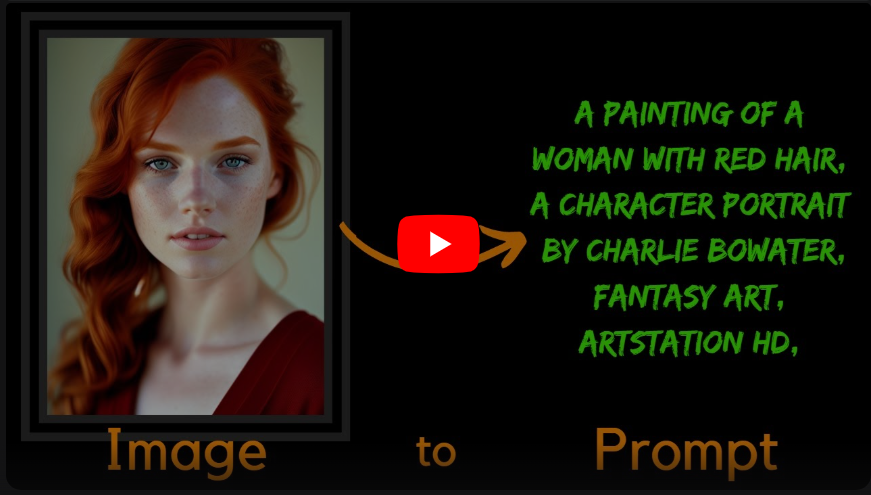
This video is relevant because it provides a visual walkthrough of the reverse prompting concept, demonstrating how tools (similar to the ones discussed) can extract text prompts from image inputs for use in models like Stable Diffusion and Midjourney.