Artificial intelligence is no longer a futuristic idea in medicine. Today, AI for doctors is becoming a practical part of daily clinical work, helping physicians save time, reduce administrative pressure, search medical evidence faster, and improve the quality of patient care. According to the American Medical Association, physician use of AI has grown quickly, with 66% of surveyed physicians reporting AI use in 2024 and more than 80% reporting professional AI use in a later survey.
The goal of AI in healthcare is not to replace doctors. Instead, the best use of AI is to support physicians, improve workflow, and help clinicians make faster, better-informed decisions. The World Health Organization emphasizes that AI in health should be adopted in a safe, ethical, equitable, and well-governed way.
What Is AI for Doctors?
AI for doctors refers to digital tools that use artificial intelligence to assist physicians with clinical and administrative tasks. These tools can help with medical documentation, clinical decision support, medical research, patient summaries, differential diagnosis support, coding, transcription, and workflow automation.
For example, AI medical scribes can listen to a doctor-patient conversation, generate a draft clinical note, and help reduce the time physicians spend on documentation. Clinical AI search tools can help doctors find evidence-based answers from medical literature and guidelines more quickly than traditional searching.
Why Doctors Are Using AI
Doctors face increasing pressure from documentation, patient volume, administrative work, and the need to stay updated with fast-changing medical research. AI can help reduce some of that burden.
One of the biggest opportunities for AI is reducing administrative workload. The AMA reported that physicians see administrative automation as one of the top opportunities for AI in medicine.
AI can support doctors in several practical ways:
- Medical documentation
- AI scribes can create draft notes from patient conversations, helping doctors spend less time typing and more time focusing on patients.
- Clinical decision support
- AI tools can summarize guidelines, explain treatment options, and help doctors think through complex clinical questions.
- Medical research
- AI search engines can help physicians find relevant studies, guidelines, and evidence faster.
- Patient communication
- AI can help generate discharge instructions, visit summaries, and educational materials in clearer language.
- Coding and billing support
- Some AI platforms help generate ICD-10, CPT, HCC, and E/M coding suggestions for review by clinicians or billing teams.
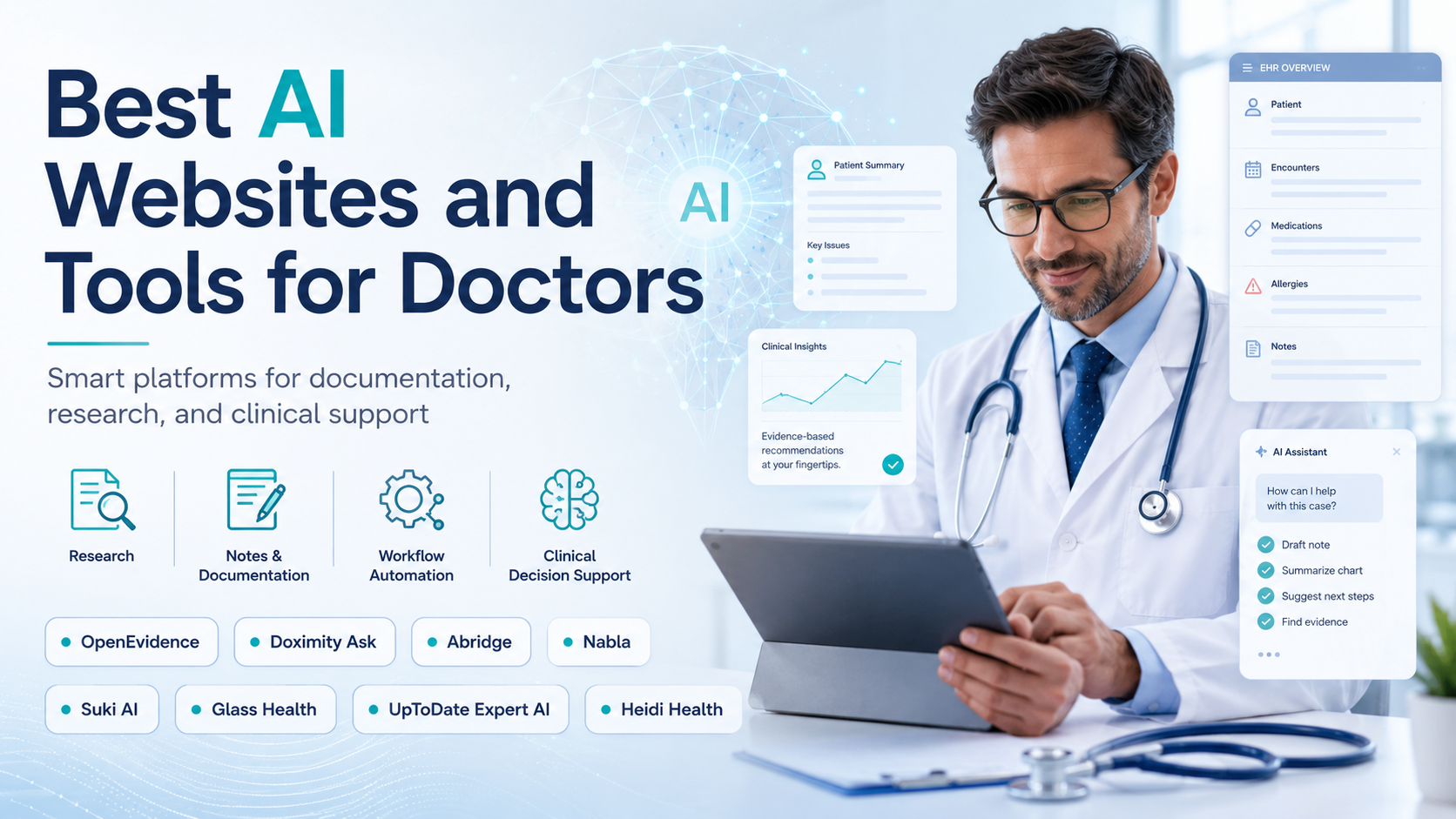
Best AI Websites and Tools for Doctors
Here are some useful AI websites and tools for doctors and healthcare professionals.
OpenEvidence is a useful AI platform for evidence-based medical search and clinical questions. It is designed for verified healthcare professionals and helps doctors find medical answers supported by reliable sources.
Link: https://www.openevidence.com
Doximity Ask is an AI-powered clinical search tool for physicians. It helps doctors ask medical questions and get answers with cited medical sources.
Link: https://www.doximity.com/ask/overview
Doximity Scribe is designed for AI medical documentation and clinical notes. It can help physicians reduce the time they spend writing notes after patient visits.
Link: https://www.doximity.com/clinicians/scribe
Abridge is an ambient AI documentation tool for clinical conversations and EHR workflows. It helps convert doctor-patient conversations into structured clinical documentation.
Link: https://www.abridge.com
Nabla offers ambient AI, dictation, medical documentation, and coding support. It is useful for doctors who want to save time on notes and administrative work.
Link: https://www.nabla.com
Suki AI is an AI assistant for doctors that supports documentation, coding, chart Q&A, and workflow automation. It helps physicians complete clinical tasks more efficiently.
Link: https://www.suki.ai/clinicians
Microsoft Dragon Copilot / Nuance DAX Copilot is an AI-powered clinical documentation and workflow automation solution. It helps doctors create clinical notes and reduce documentation burden.
Link: https://www.microsoft.com/en-us/health-solutions/clinical-workflow/dragon-copilot
Glass Health provides AI-powered ambient scribing and clinical decision support. It can help doctors with documentation and clinical reasoning support.
Link: https://glass.health
UpToDate Expert AI offers evidence-based clinical decision support powered by UpToDate content. It helps healthcare professionals access trusted medical knowledge more efficiently.
Link: https://www.wolterskluwer.com/en/solutions/uptodate/ai-clinical-decision-support
Heidi Health is an AI clinical documentation and care workflow tool. It helps doctors create notes, letters, and other clinical documents faster.
Link: https://www.heidihealth.com
FDA AI-Enabled Medical Device List is a useful resource for checking AI-enabled medical devices authorized in the United States. It helps doctors and healthcare organizations review regulated AI medical technologies.
WHO Artificial Intelligence for Health provides guidance on the safe, ethical, and responsible use of AI in healthcare. It is a helpful reference for understanding AI governance in medicine.
Link: https://www.who.int/publications/m/item/artificial-intelligence-for-health
How AI Helps Doctors Save Time
One of the most popular uses of AI for doctors is automated documentation. Instead of typing long notes after every visit, doctors can use an AI scribe to generate a draft note from the clinical conversation. The doctor still reviews and edits the note before it becomes part of the medical record.
This is important because clinical documentation is one of the most time-consuming parts of medical practice. Tools such as Abridge, Nabla, Suki, Doximity Scribe, Microsoft Dragon Copilot, Heidi, and Glass Health are designed to reduce that burden by supporting documentation and workflow automation.
AI for Clinical Decision Support
Another major use of AI for doctors is clinical decision support. Doctors often need to review guidelines, compare treatment options, check drug information, or search recent medical literature. AI tools can make this process faster by summarizing evidence and pointing clinicians to sources.
OpenEvidence, Doximity Ask, and UpToDate Expert AI are examples of tools designed to help doctors answer clinical questions using medical sources and evidence-based information.
However, doctors should not use AI answers blindly. AI can make mistakes, miss context, or generate incomplete information. The physician remains responsible for reviewing the output, applying clinical judgment, and making the final decision.
Is AI Safe for Doctors to Use?
AI can be helpful, but it must be used carefully. In healthcare, accuracy, privacy, consent, and accountability are critical. Doctors should choose AI tools that are designed for medical use, follow privacy requirements, provide reliable sources when needed, and fit the clinic or hospital’s compliance policies.
The FDA maintains a list of AI-enabled medical devices authorized for marketing in the United States, which helps healthcare providers identify AI tools that have gone through a regulatory process.
The WHO also stresses that AI in healthcare should be governed responsibly, with attention to safety, ethics, equity, and regulation.
Benefits of AI for Doctors
The main benefits of AI for doctors include:
- Less time spent on documentation
- Faster access to medical evidence
- Better organization of clinical information
- Improved patient communication
- Reduced administrative burden
- Support for coding and billing workflows
- More time for patient care
When used correctly, AI can become a powerful assistant for doctors, especially in busy clinics, hospitals, emergency departments, and primary care settings.
Limitations of AI in Medicine
Despite its benefits, AI has limitations. It may misunderstand clinical context, produce inaccurate summaries, miss important details, or generate suggestions that are not appropriate for a specific patient. AI tools may also raise privacy and consent concerns, especially when they process sensitive patient conversations or medical records.
For this reason, AI should be treated as a support tool, not an independent medical authority. Doctors should verify outputs, check original sources, follow local laws and policies, and always use their professional judgment.
The Future of AI for Doctors
The future of AI for doctors will likely include more advanced medical assistants that can combine documentation, research, patient history, imaging, lab results, and workflow automation into one connected system. Instead of replacing doctors, AI will probably become a digital partner that helps physicians work more efficiently and focus more on human care.
The doctors who benefit most from AI will be those who understand both its strengths and its risks. They will use AI to save time, improve workflows, and support decision-making, while keeping clinical responsibility, empathy, and patient safety at the center of care.
Conclusion
AI for doctors is one of the most important changes happening in healthcare today. From AI medical scribes to clinical decision support tools, artificial intelligence is helping physicians reduce paperwork, access evidence faster, and improve daily workflow.
The best approach is not to ask whether AI will replace doctors. The better question is: how can doctors use AI safely, responsibly, and effectively?
When used with human judgment, strong privacy standards, and evidence-based practice, AI can become a valuable tool for modern medicine.